August 14, 2025 //
Matrixx Ferreira //
Sport Performance //
5 min read
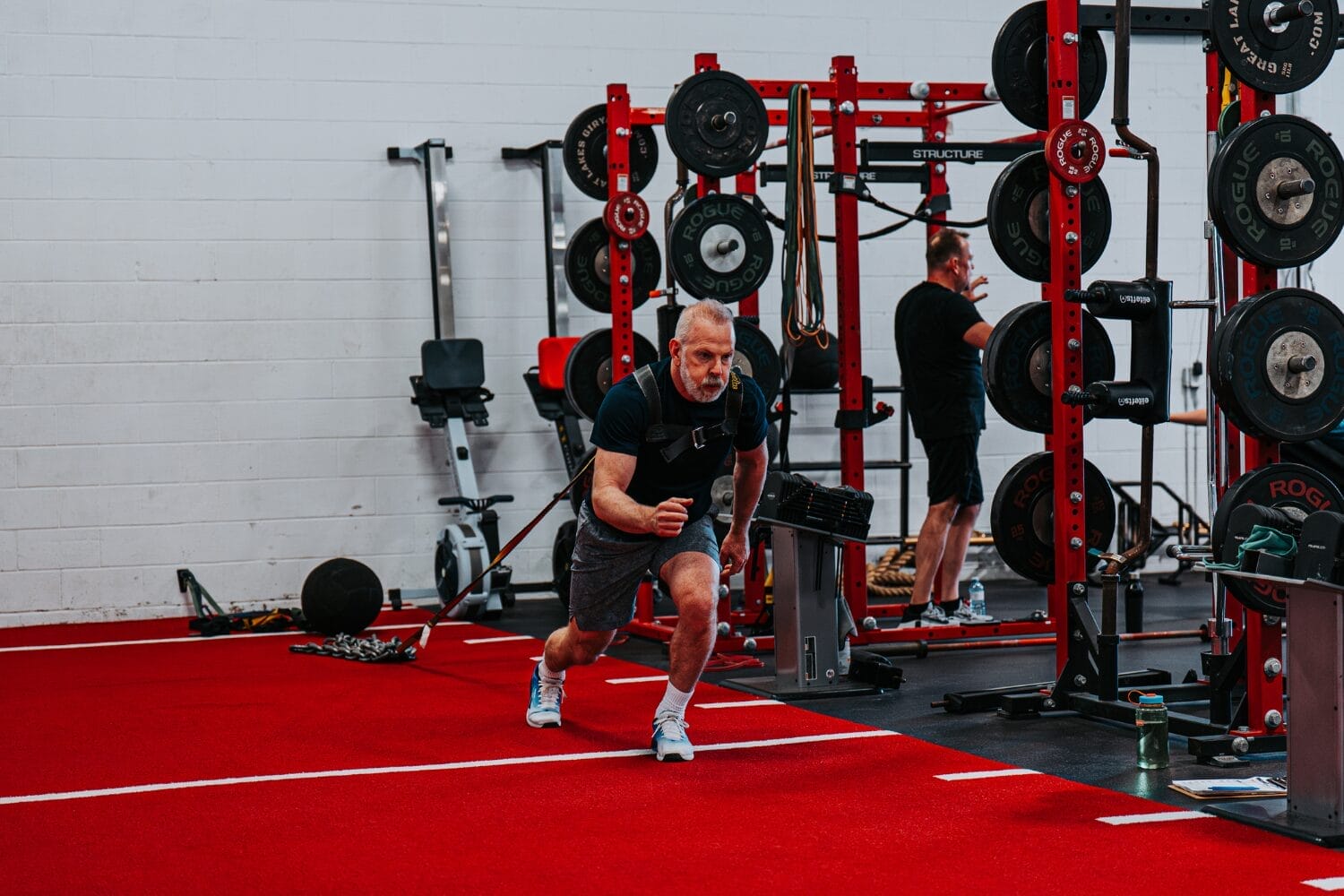
Coaches talk a lot about resisted sprinting — how it builds horizontal force, cleans up mechanics, and improves acceleration. It’s one of those staples in speed and power training, a go-to for athletes looking to crank up their game.
But here’s the real talk: most of the time, we’re just guessing how much resistance is “enough.” We grab a sled, slap on some plates, and hope for the best. Maybe we say, “20% of bodyweight,” or “as heavy as they can move,” but is that really optimal? Or are we just throwing shit at the wall, hoping it sticks?
I decided to stop guessing.
Instead, I ran a simple test on myself to figure out where the sweet spot lives — the load range that challenges speed without crushing mechanics or turning the sprint into a slog. The key metric I used? Velocity Decrement, or Vdec%.
What Is Velocity Decrement?
Velocity Decrement is just a fancy way of measuring how much slower you run when resistance is applied. It’s basically a percentage drop in your sprint velocity from unresisted to resisted sprinting.
Here’s the formula:
So if you sprint 20 yards at 6.18 m/s without resistance, and 5.55 m/s with a sled, your Vdec is about 10%.
Why does this number matter?
Because it gives you a precise way to quantify the training load based on how much your speed actually drops. It’s one thing to say “add some weight,” but it’s another to say “add exactly enough weight to reduce your velocity by 10%.”
Here’s a rough breakdown of what different Vdec zones mean:
<10% — Too light. Minimal overload. You’re barely challenging the system, so gains might be limited.
10–15% — Optimal zone. You get a power-focused overload without sacrificing sprint mechanics.
>15% — Risk of excessive mechanical breakdown. Sprint form starts to fall apart, and you’re training a grind, not speed.
This concept isn’t new. Coaches and researchers like Les Spellman and JB Morin have talked about it for years. But until you test it on yourself or your athletes, it’s just theory.
How I Set Up My Test
I wanted to keep things simple but precise. So here’s the setup:
Sprint Distance: 20 yards (18.29 meters) — short enough to hit max effort and acceleration.
Body Mass: 83.3 kg — me.
Loads Tested: From 6 to 32 pounds of resistance using the AK Powercord, adding 4 pounds at a time.
Timing: Vald Smart Gates
Data Recorded: Sprint time, which I then converted into velocity and calculated Vdec%.
Each sprint was logged carefully. My baseline — unresisted sprint — was 2.96 seconds over 20 yards, which equals about 6.18 m/s.
What the Data Showed
Here’s the breakdown:
What’s interesting is that the Vdec percentage crossed that 10% threshold right around 24 pounds of resistance — which was about 13.1% of my bodyweight.
Both graphs are below:
Loads heavier than that put me in the “sweet spot” of 10–15% velocity decrement, which research and coaching wisdom suggest is the ideal zone for resisted sprint training.
Why This Matters More Than You Think
Too often, coaches throw a heavy sled, chains or bands on an athlete and call it speed work. But if the athlete is moving slow, overstriding, or breaking posture just to get the load moving — you’re not training speed. You’re just muscling through what you think is “sprint work”.
By testing velocity decrement, I now know exactly how much load challenges my speed without compromising form. It’s not just adding resistance for resistance’s sake; it’s targeting a specific zone where the nervous system adapts to produce more force at speed.
Plus, this approach is athlete-specific (exactly what we’re all about at Iron Performance Center).
It’s not a cookie-cutter percentage pulled out of thin air. It’s not a “one size fits all.” It’s a test-based, individualized method that respects how each athlete responds differently to resistance.
The Caveats
While this experiment provided interesting insights, we should note a few caveats to the experiment.
The baseline sprint should be max effort, with a proper warm up. Anything less will (of course) bias and skew the results.
Economy of sprinting skill should be optimized first. I’m no track star, but having some experience with the fundamentals of sprinting will make using specific Vdec numbers more effective for everyone.
Different Vdec zones can be useful for different goals.
Although I gave myself rest in between trials, aim to minimize trials to find the appropriate Vdec zone. Fatigue and stress will accumulate and take away from future efforts; in order to maximize trials, try to “miss small”.
This experiment was a single moment in time. I wasn’t actively trying to improve my sprint time leading up to this, I simply warmed up and went for it. Messy action.
How You Can Use This
If you’re a coach or athlete, here’s what I recommend:
Test your own baseline sprint velocity without resistance over a short distance (10-20 yards/meters).
Add incremental sled, chain or tether loads and measure sprint times.
Calculate Vdec% to find your ideal load zone — where you hit that 10-15% drop.
Program resisted sprints using that load, knowing it’s enough to overload but not so heavy that it breaks mechanics.
Re-test periodically to adjust the load as you get stronger and faster.
Final Thoughts
If you’re not measuring, you’re winging it.
This little experiment took me 20 minutes and gave me real answers. As a coach and athlete, it’s a reminder that the details matter. What looks hard doesn’t always deliver the right stimulus.
And when it comes to speed, there’s a fine line between overload and overkill.
This is what we do at Iron Performance Center; show your work, assess, implement and get closer to the mark. The goal remains the same:
Sprint better. Sprint faster. Sprint smarter.
Matrixx Ferreira – Director of Strength & Conditioning